
Bee Jaw Mississippi
Updated: Jul 29

As I sit at the very back of the stern of the S.S. Badger, a flood of thoughts and memories overcomes me.
The Badger, an enormous car ferry, is a decades old National Historical Monument, but it is also a living, working, black smoke-belching way to cross Lake Michigan. As I sit with my big feet up on the back rail, watching the seagulls dive bomb into the churning waters and Ludington Michigan fade into the distant horizon, dozens of cars, trucks, tractor trailers, and motorcycles, including mine, lay at rest in the bowels of the ship. A couple hundred of us eager seafarers are settling in on the top deck for the three-hour crossing [no Gilligans here] that will take us all to Manitowoc Wisconsin, where we will disembark, and I will either race or piddle the five-plus hours home.
But before we do, and I do, I have an entire Great Lake crossing’s time to muddle through the brain bushel of images that clog my tired head.
[Author’s Note: OK you hair-splitters: Yes, according to Merriam Webster piddle does mean to urinate. But it can also mean to dawdle; to meander. So, this becomes an “it’s my party and I’ll cry if I want to…” sort of thing, and since this is my blog, I will blast the 320 miles to Minneapolis or I will piddle the width of the Badger State, stopping at every “Old Style” neon-adorned tavern that I see. Either way, I will not be pissing away my last day of my trip, unless you mean figuratively. On the other hand, if I get enough Old Style lager in me, it could be true literally as well. Sheesh. What is wrong with me? Please, I’m trying to be serious and wax poetic here—so give me a frickin’ break.]

I have spent dozens of hours now, riding solo for thousands of miles, taking in the endlessly extraordinary stream of beauty, cultural, and historical significance—while living inside my own head as the miles rolled by.
With only a few exceptions, the only sounds I heard for over six weeks of motorcycling were the monotonous thumpity thump of my Harley Davidson M8 motor, and the screeching of the wind in my ear. When I finished the five to seven hours of motoring along each day, I either crashed within minutes of checking in to a motel or I went thoughtlessly bar hopping—in search of cold beer and what little social interaction an out-of-towner can generate within the few waking hours that I was going to spend in each town along the way.
Except for Hannibal Missouri, Memphis Tennessee, Clarksdale Mississippi, Asheville North Carolina, and New Orleans Louisiana, I never spent more than a single night in any place that I bedded down. I am ashamed to write that, as every one-day visit that I passed through deserved at least a few more days and even more—of their own, and maybe someday I’ll go back and give each one their just due.
However, one thing I did not do, was reflect. I thought about virtually everything that I saw. I pondered each individual implication. I analyzed what I saw for what it meant, or what it could mean. Very often, I was amazed by something that I saw that I didn’t know of or really understand. I was, after all, riding solo for seven hours a day with no one to talk to or think with, but myself. The truly astonishing element of my motorcycle trip was the fact that every single day on the road I learned something(s) new, saw some, or many wondrous things, and experienced the ultimate freedom and joy that comes with riding a motorcycle across a large swath of the United States of America. And yet, each day’s revelations were, in a sense, unrelated segments— a series of experiences each of which was stand-alone—and rightly so.
Now, at this moment, watching as the wake of the S.S. Badger strings along behind and then melts into Lake Michigan, I am starting the next journey—the one where I look at, and think about all of it in relation to the whole. The South, and its part in our country’s history, the often breathtaking to the point of imposing—physical prominence of the Mississippi River, as well as what it once meant, the cause and effects of the demise of rural America, and “my/our” part in it. Past. Present. The future.
But I don’t want to wax too overly poetic; that is to say, I don’t want to wax on, boringly. In the end, it was just a motorcycle trip. In the end I am just a fat old guy motorcycle-riding away my "Golden Years,” like so many thousands of us do—trying to find some way or means of remaining relevant to our peers and loved ones for doing something cool—while we inevitably drift into permanent irrelevance… and not think about the fact that we’re also drifting ever closer to our own demise.
Therefore, I am more than aware of the fact of, Who Cares?
Still:
I shouldn’t admit this, but when I’m not living in Paris or Amsterdam, and when I’m not galivanting around on my motorcycle, often I can be found sitting in a big and tall-sized lawn chair on my front lawn in Minneapolis Minnesota with an old red Coleman cooler that is chock full of well-iced Grain Belt Premium beer.
Very often. As in, almost every day. Even in winter.
I offer a beer to all who pass by—the dog walkers, the baby stroller pushers, the exercise fanatics, the promenading lovers, the fellow gimps who, like me, have a freshly replaced hip: everyone except the little kids who pedal by uncomfortably because their goddamn fathers won’t raise their bicycle seats (a pet peeve), everyone is gregariously greeted by me waving a can of beer in their general direction.
Hardly anyone accepts my uncommon generosity but virtually all of them do join me in a neighborly chat. They’re all full of interesting facts and figures, and over the years we have grown to know each other well—we are all like two chatterbox ships respectively passing each other in the night, only its almost every single day—and I am greatly saddened when one or another changes their daily route, moves, or dies.
One of my favorite passersby is my neighbor Cindy, who twice daily walks her hyperactively spastic dog Ciao Chow around the neighborhood, probably in the hope that he will tire himself out. Cindy is always fashionably dressed, and they make quite a pair, with Cindy walking along elegantly while Ciao Chow rockets around on his leash like Ricochet Rabbit after he drank way, way too much espresso.
Cindy is also exceedingly intelligent—way smarter than me, and our frequent dialogues can be as simple as the confounding Minnesota weather, or as complex as the social and political environment of our home city. One of the really exceptional things about Cindy is, she leads groups of young people on tours to Memphis, including the Cotton Museum and the Civil Rights Museum that is housed in the Lorraine Hotel; to Clarksdale Mississippi and around the surrounding Mississippi River Delta; all through the South, really, to the courthouses, museums, galleries, and the endless sites of historical significance.
I would say that she is fearless and is as self-confident as any woman that I have ever met. She loves Mississippi, goes often, and yet when I shared my detailed plans for my recently completed journey, she stated simply that she would never drive by herself through Mississippi to or from New Orleans. As a single African American woman she simply could not, and would not attempt it, even in a car.
I have come to love Mississippi also. It was very mystical and wondrous to me, much as in a very generalized way Maui, Hawaii was and still is for me a most mystical and wondrous place.
And yet, how do I reconcile my love for it with the experiences and fears that my dear friend Cindy herself has, and what Cindy represents, for a place that she loves more than I do?
Also:
Between Clarksdale and Natchez Mississippi is a charming little gem of a city named Port Gibson. In many ways it is a living relic of the Old South, and yet there was enough modernization around town that it didn’t feel like a museum. The main street was comprised of a seemingly thriving row of functioning businesses, cafés, and shops, while on the main highway there were twenty or so antebellum mansions that were impeccably kept. Each had a small historical placard in front of it detailing each house’s elaborate history, all of which, of course, I stopped and read. The pictures that they painted, and the stories that they told, carried some of the mundane, but they also described a life that to me as a northerner—sounded as foreign as if it were in Oostende, The Netherlands, or Sarlat-la-Canéda, France.
My initial entrance into Port Gibson was sketchy, and more than a bit frightening because I had until then been riding for hours without interruption, which caused me to inadvertently ride into town way too hot. As luck would have it, I whizzed by the 25 MPH sign at about fifty-over exactly in front of a speed-monitoring Port Gibson police officer, which caused my heart to go from 80 beats-per-minute to 297 beats-per-minute, and I may have piddled in my pants.
I geared down, furiously, while at the same time jamming both my front and back brakes just shy of going into a power slide. Then, with an air of sad and fearful resignation I stared at my rear-view mirror and waited for the flashing lights and who knows what else that was inevitably to come.
Much to my surprise, the officer didn’t come flying out of his spot, sirens a-blaring, and in my overly imaginative mind, unsnapping the safety strap that held his 9mm Glock 43x service revolver in place inside his 76-pound police belt and holster. Instead, he drove out, and then into a gas station/convenience mart that was next door to where he was initially parked.
I literally heaved a lung-busting sigh of relief and rode into Port Gibson for a sightseeing tour.
Proof of Port Gibson’s modern ways immediately came upon me while I examined with great interest the Civil War memorial monument that towered above everything in the town square. I have seen countless memorials to the uniquely American conflict: I’ve visited Gettysburg, where I spent three days reading everything I could find in the museum and on the battlefield; I walked around the ditch of Antietam, where men stood twenty yards from each other blasting away with cannons and any other weaponry they could get their hands on—until pretty much all of them were a tangled mass of bloody dead; I toured Chattanooga, and Bull Run; and I even walked around Harper’s Ferry, where old John Brown lit a match. I had read about many more, and I also read about the Southern monuments to their fallen Confederate heroes and their revered officers— and the recently hot and heated debates regarding them, along with the continued use of the Confederate battle flag in and flying above state government buildings.

I had read about them, but I’d never seen one until I closely examined the monolith in Port Gibson and realized it was 100% dedicated to the Confederacy. I didn’t have any time to think about that or its implications, however, because no sooner was I able to snap a few pics when a thoroughly modern homeless person came out of nowhere and pressured me to hand over any spare money (an oxymoron if there ever was one) that I had. For some reason, I decided to affect my worst Bostonian accent while explaining that I was a credit card man by nature, and I was starting to enjoy our back and forth when I started to feel a presence behind me. After a minute or two, I turned around, and there he was: my Port Gibson constable from out on the highway.
Suddenly, I felt like my Minnesota license plate was a drive-in theater-sized neon, and my new follower was watching Gone with the Wind on his department-issue iPad while listening to Neil Young’s “Southern Man” on his squad car radio.
I cut my homeless guy short and slowly pulled away from the city square. As I moved down main street, I saw the policeman ease along a respectful 30 yards behind me. I turned left on Broadway, and after a few moments so did the policeman. I turned right on First, and so did he. I looped back around for another tour of main street, as did my gum drop-topped shadow. Finally, I quit the Port Gibson charade/parade and headed out and onto the highway. I stayed exactly two miles under the 25 MPH speed limit as I rode out of town, and so did my escort—until I passed by the “Thanks for Visiting Beautiful Port Gibson” sign, whereupon my day’s biggest fear turned around abruptly, and raced off in the other direction.
I rode the entire way from Port Gibson to Natchez at exactly the speed limit, and I drove by Vicksburg without even stopping—which totally killed me.
A few days later, I found myself sitting at the No Name Bar (surprise!) in Natchez, and after sharing some Harley Davidson-related pleasantries with the most gracious and superiorly skilled bartender/motorcycle mechanic—I trusted the happy fellow enough to share my Port Gibson experience.
In his best southern drawl (I left the Matt Damon thing back in Port G.), he told me that he had grown up around Port Gibson, and that I had it all wrong. The cops were all nice guys, he assured me, and he added that they were motorcyclists themselves, and had a sweet spot for us bikers.
“He was making sure you stayed safe while you were in his town,” my guy promised.
I have had a lifetime of these kinds of experiences with differing conclusions, and this most current excursion was, I can’t say troubling, but it was for sure thoughtful.
Was the Dixie bartender from Natchez right about why the cop followed me around until I left the Port Gibson City Limits, or did the fat Yankee on the loud Harley represent something sinister that needed to be attended to—at least until I left town?
—
I am home now, in Minneapolis, the old ways Lutheran “Minnesota Nice” state that is now a newly minted, angst-riddled home for anger, unrest, and uncertainty. The Harley is in the shop getting a thorough going over, and hopefully a New Orleans Garden District beauty shop-level wash and perm.
I’m exhausted but recovering—when one rides day after day for weeks on end one goes all day, sleeps, and gets up and does it again and again without ever allowing the effects of the ride to creep into the on-the-road-again physical and mental consciousness. Then one, especially an old, fat one, stops the routine abruptly upon crossing the finish line and it all catches up to the point of one’s near collapse.
While catching up on chores at a snail’s RNR pace, I am doing a fair amount of reflecting, but I’ve re-learned that after the perfunctory, “how was your trip,” the people around me are not really interested in my emotional ruminations.
[Re Hairsplitter: “philosophical ruminations about life and humanity,” NOT me as a cud-chewing cow.]
Therefore, I pretty much stick to paraphrasing the words of my hero, Iggy Pop, and simplify my answer to, yeah, the ride was a real cool time.
On the other hand, I do share my joy that I was able to see my Detroit friends that I hadn’t seen in 30… 40… and even 50 years—and reaffirm that the Detroit area still has the best real people food in America.


Buddy’s Pizza is still the best pizza in The World. Pegasus, in Greektown, has the best Skordalia. Lafeyette (and American- next door) Coney Island has the best (correct) coney island hotdogs in the whole Universe. And Chef Greg’s soul food joint has been able to reconstitute the Ninth Wonder of the World— The Boogaloo Sandwich(!), first made famous way back in the day, at least to me and Gerald Shohan, at Brother’s Bar B Q.
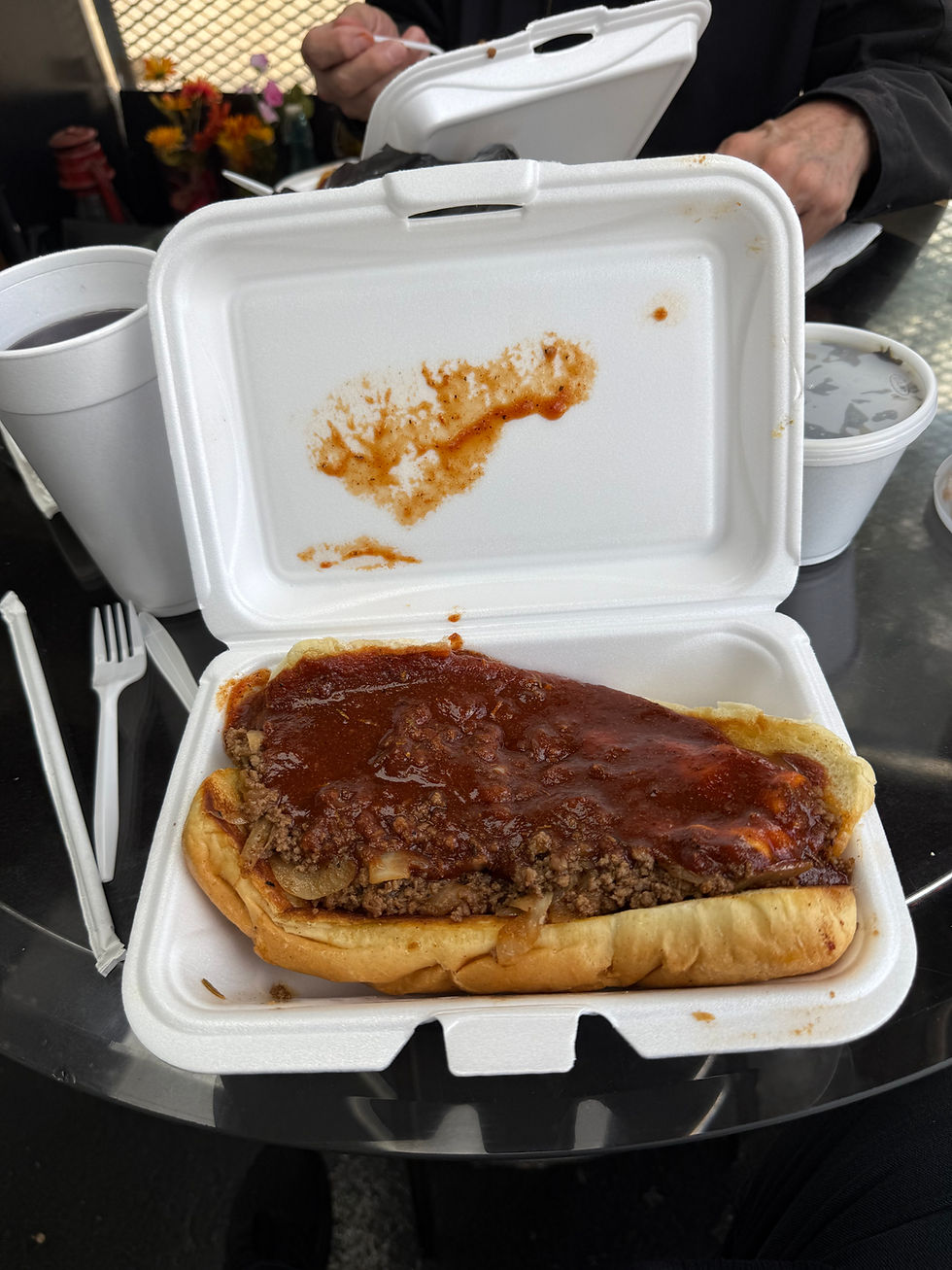
Anyway, I'm home now, plotting my next motorcycle trip through New England, and reflecting heavily upon the incredible gift that My Great Mark Twain/Memphis Barbecue/Delta Blues Motorcycle Trip became. It was life-changing, and I will cherish that motorcycle ride for the rest of my days.
Still, I would be remiss if I didn’t share the final event of this whole motorized shebang.
Back a month or so in Memphis, Rachel had flown in and joined me for a few days and, as a lark, while strolling around town my sweety encouraged me to get fitted for a sport coat-type thing at Lansky Bros, which is a Memphis landmark clothing store as well as serving as “Clothier to the King.”
As in, Elvis.
She had caught me admiring a super cool jacket in the Lansky Bros storefront window, much as The King had just before he became famous—which on his part led to at least a couple of the coolest ensembles in rock and roll history.
The senior Lansky, Bernard, endeared himself to the yet to be recorded Elvis after inviting him inside the shop in 1952, and did indeed become his primary clothier. Many trend-setting outfits ensued, including custom designing the hip-as-all-get-out pink sport coat that Elvis made famous—which Rachel decided would look as kickass on me as it did on him.
Which, I know, is a Grand Canyon-sized stretch, but I went along with it anyway. I was measured and remeasured, stick pins, chalk, and all, by none other than Hal Lansky himself, which might be one of the proudest moments of my life!
Skip ahead to many weeks later, and upon entering the house for the first time after my ride of a lifetime I noticed a garment bag sitting on the couch with “Lansky’s” spelled out across it in large flamboyant letters. I left it be, but the next day we had a bag opening ceremony, and while my sister-in-law Amy played “I Feel Good” (courtesy of James Brown) on her cell phone I was goaded into “walking the catwalk” back and forth across our back porch while wearing my new, perfectly tailored pink sport jacket. I believe for sure that the alley neighbors were somewhat shocked at the sight of the hippo-sized, proud-as-a-peacock pink flamingo that was herky-jerking for seemingly no good reason at all, but I was the Proudest Hippo-Sized Pink Flamingo of a hip-shimmying rock-n-roller in the world.

So, I understand that my new coat does not make me anything approximating a king of anything, let alone anything relating to music. However, the next time I ride my motorcycle anywhere, I will be wearing my pink roller jacket.
And that will make me the greatest looking King-Hell, Bad MoFo Motorcycle Flâneur ever.


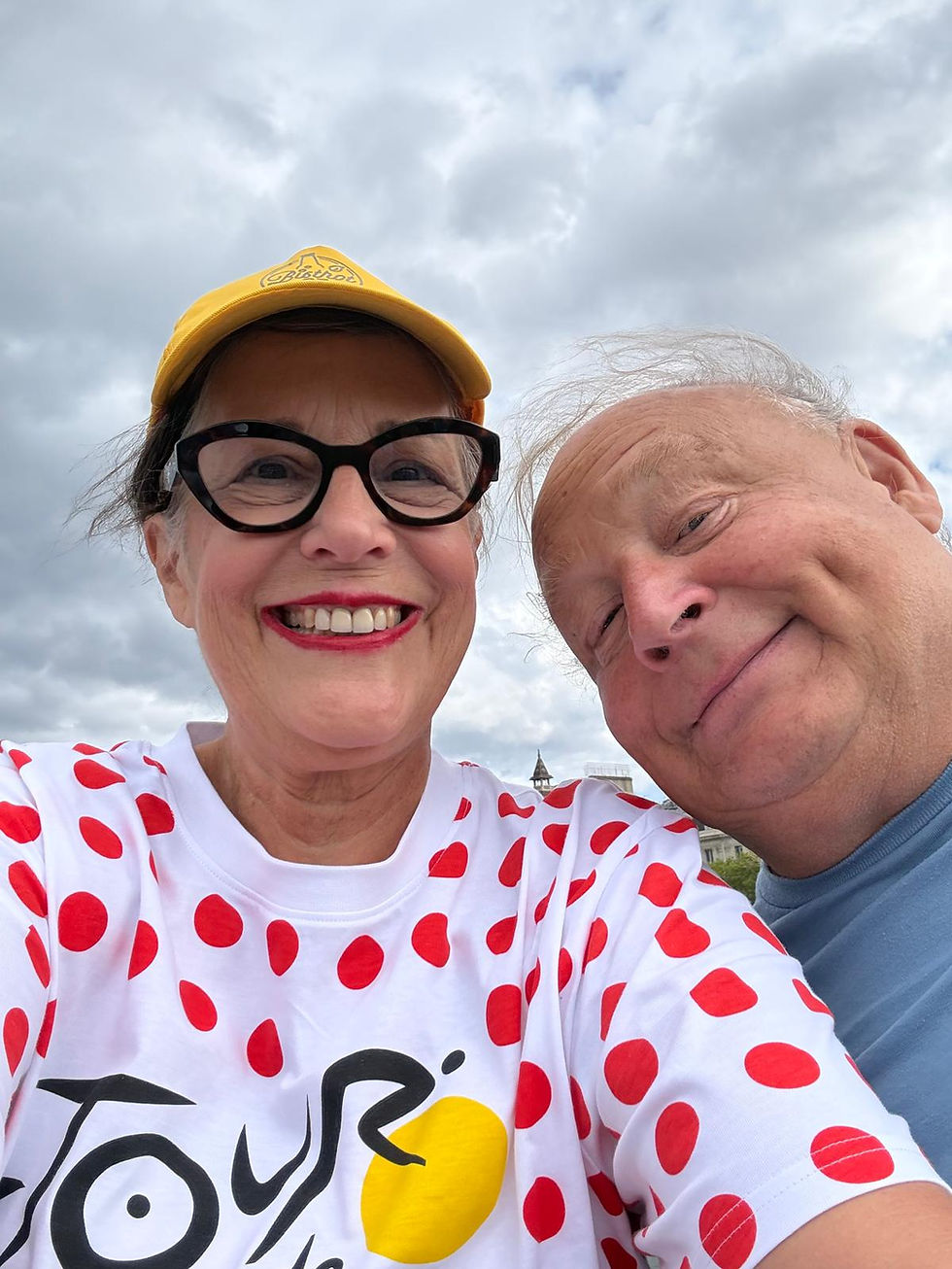
I am happy for you Mark, because your stories make me happy. I hope we can see each other someday soon. I miss you my old friend!
Love this one, great to have you back in Minnesota.
'Love, love, love every detail and image! I'm craving a cream ale, now...
Great fun! I enjoyed every word. Keep on waxing-on, my friend. Let us know when you do you NE trip.
Yes, a photo modeling the pink jacket is necessary.❤️